Episode 41 · · 36:26
You Can’t Market to an Algorithm: How AI Reads, Speaks and Queries Your Brand
About this episode
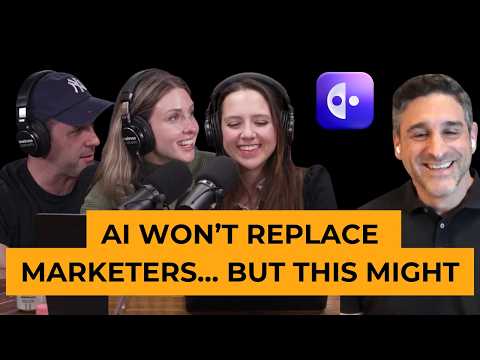
AI now stands between brands and their customers in almost every channel. Marina Petrova, CEO and co-founder of Intentful, got into OpenAI’s closed beta in 2021 after COVID wiped out her travel business, and tells Rob May and Lauren Slyman what it taught her: AI reads a brand, speaks as it and queries it, so brand guidelines matter more than ever, and “marketing to agents” misreads what agents are. The news segment covers a PHP patch exploited within minutes, Niall Ferguson and Eric Schmidt on AI and world order, and why commit volume pushed Anthropic to build its own source control.
- Enterprise AI
- Agents & Software
Guest

CEO & Co-Founder, Intentful
Key takeaways
- Marina Petrova says the biggest gap between AI hype and reality is education: people don’t know what agents actually do, so she walks marketers through tokens, vectors and weights. Even knowing to switch from an instant model to a thinking one gets much better results.
- After COVID ended her online travel business, Petrova got into OpenAI’s closed beta in 2021 and used a fine-tuned Davinci model to write content for performing arts venues, who saw results in Google within months.
- She says AI reads a brand, speaks as the brand and queries the brand. Brands no longer control every word and pixel on the way to the consumer, and AI blends hundreds of sources into patterns, so the work is structuring the brand for the AI search index and live retrieval.
- “Marketing to agents” is a misconception, Petrova argues: agents are algorithms, not people. Many brands don’t clearly know their own guidelines, and while they debate them, “AI will be building your brand equity without you.”
- Rob May recalls BrandGuard, his startup that screened content against brand guidelines: a Fortune 100 prospect with an 11-person brand safety team stalled by deciding to rewrite its guidelines first.
- In the news segment, Rob argues AI makes strong economies stronger and that racing to superintelligence may be the wrong game. Petrova and Lauren Slyman agree the winners will be the countries that get adoption right.
Transcript
Transcript generated automatically from the episode audio and lightly cleaned up (filler words removed, misheard names corrected where clear). Speaker labels were added afterward and may contain errors.
Rob May: Hi, everyone. I'm Rob May. I'm the co-founder and CEO at Neurometric.
Lauren Slyman: I'm Lauren Slyman. I am a user researcher at Microsoft.
Rob May: And you're watching the AI in NYC Show. All right. Welcome, everybody. We've got a good show today. A couple of housekeeping things. First of all, subscribe if this is your first show. Secondly, we're launching a series of newsletters, so go to the website. We have one about New York, and we're launching some other ones that are very focused on specific career roles in AI. If you like those, you should go subscribe. And third, I've mentioned this before, but I published a book, Investing in AI. You should check it out. There's a link on the website.
Rob May: Before we get started today: Anna, who's not here today, always likes it when we have a hot take. So I was telling you guys this story. I have a hot take on bottled water, because I typically drink Smartwater or Fiji Water, those are my favorites, and they're always in plastic bottles. When I was in Europe this summer, it was always glass bottles, and I was like, this tastes so much better. I'm going to come back and do the glass bottle thing. The very first set of glass bottles I brought home, I go to open the first one, I drop it, and it shatters all over my floor. And I'm like, this is why we don't use glass bottles.
Rob May: So I started trying different kinds of water, and it's funny, I've settled on the cans of Liquid Death. It's really good. And it's funny because when this brand came out, I thought it was the stupidest thing in the world. It's water made to look like beer or whatever. I think the original reason was so people going to raves or bars who don't actually want to drink can drink something and feel normal with everybody else. But it's actually really good, and I think it tastes better out of a can. It's not quite a glass bottle, but I've moved entirely away from plastic bottles. Just for the taste. Maybe microplastics, maybe not, I don't know.
Lauren Slyman: What about the cartons, like the boxed water?
Rob May: I've tried that, that's good. I haven't seen it for sale in bulk. But do you have a preference?
Lauren Slyman: Not cans, not boxed cartons. Glass. The most inconvenient form it can come in is what I'd like to drink out of.
Marina Petrova: For sure.
Rob May: All right, so we're going to talk about a couple of things today. We have a guest who is very deep in the brand and advertising side of AI. Our guest today is Marina Petrova from Intentful. Marina, welcome to the podcast.
Marina Petrova: Thank you. Thanks for having me. Glad to be here.
Rob May: So I want to jump in. There's a lot of hype surrounding AI agents: autonomous workflows that do everything with no oversight. You're deep in this with brands. Where do you see the biggest disconnect between the hype, the things people are saying you can do, and what people are actually doing and using it for? And what's working?
Marina Petrova: That's a great question. I talk about this almost every day, with clients or with media. I think the biggest disconnect is that there is so much noise, but it's just people trying to understand what agents do and what AI does in general. There is not enough education or understanding about what the agents actually do, what they are capable of doing and how they work.
Marina Petrova: I think the frontier labs could do a much better job of educating people and actually showing things. Literally yesterday I was doing a webinar for the WFA, the World Federation of Advertisers, called How AI Generates Brands. It's about brands in AI, because that's my topic, but I walked them through every single step of what happens: there is a question, and then there are tokens, and then there are vectors, and then weights and all of that. Because I think that's the education part that is lacking. Otherwise everyone just heard something on TV, and that's what they think the agents can do. So I think that is the structure that is missing at this point.
Marina Petrova: It's like, again, you can hear my accent, it's like learning a foreign language. You can memorize things, but it's always good to know the grammar and the rules, to know exactly what the right thing is. I think it's exactly the same with agents. That's why the disconnect is a lack of general education, I would say.
Lauren Slyman: When it comes to learning about AI, I hear a lot of focus on usage and how to use the tools. What about the how-it-works portion of it, understanding tokens and vectors and how it's going through a system and being processed? What about that do you think is most useful for the average consumer to learn?
Marina Petrova: I think some basics are still important. Yes, you can memorize things, and also everything changes every day, there are new features in the tools, but there are some basic things people can learn. For example, the difference between the thinking levels. I hear this all the time. People say, yes, it does 95%, and then I spend 5% fixing everything else. But they just don't know that you can change from the instant model to a little bit of thinking, and then you would get a much, much better result. So some of the basics, and then a lot of use cases, would be incredibly helpful, because we're all different. We all have different ways of learning and working. So showing and not just telling is always a good idea.
Lauren Slyman: Basics are really important. Do you think knowing how these things work at the technical level brings people away from the fascination with AGI and what these things should be? Because a lot of people are like, it's just math, right? It's matrix multiplication, vector embeddings. And you're like, it's not.
Marina Petrova: Exactly. And I think a lot of the fear that people have can go away once they understand that it is an algorithm. Yes, it's a really smart algorithm. And yes, it is thinking. Sometimes it can be scary. But once you actually know what it is, once you are informed, you know how you can start using it in your job, or what it does to your brand, and you don't just stay in the unknown.
Rob May: And then, of course, think about the percentage likelihood that it will kill us all. Did you come up a technical path and then get into brands? Or did you get into brands and then realize, I have to learn how this technology works?
Marina Petrova: I was on the brand side first. I was thinking about this this morning: I have almost 30 years of experience, and about half of that was on the marketing communications and brand side. The technology side started about 20 years ago, when we started a digital marketing production business, and that's how I started working with developers. I still work with some of them. Then I had an online travel business called New York Online, because of my love for New York City, to help people who don't speak English.
Marina Petrova: That was before AI. It was eight languages, people from 50 countries and so on. That's where technology came in, because there was e-commerce and all of the analytics and everything. Then COVID killed that business. And then we actually started an AI company in 2021, a couple of years ahead of ChatGPT, working with OpenAI. By that time I already understood technology really well and I was learning. And now it's this perfect intersection of brands and AI, and I absolutely love it.
Lauren Slyman: Before ChatGPT, you could argue the masses were not really aware of generative AI. How did you spot those trends ahead of time and understand that Intentful could be something big?
Marina Petrova: I remember that moment. Speaking of books, you have the book; I don't have a book yet, but if I ever write one, that would have its own chapter. So, COVID: the online travel business obviously no longer exists. I had conversations with another company, which was a competitor at that time, and we really liked how each other's businesses worked and shared business ethics. But there was no business. So what can we do? It's 2021. Let's see, maybe we can merge our businesses. Okay, maybe we can, but there is no business. No one's traveling. So we started looking into what we could do.
Marina Petrova: Later on we merged our companies, and my business partner said there are several companies in the performing arts space, like Broadway, coming out of COVID, and they need help. Let's see what kind of help we can provide. They told us, again, 2021, a different level of AI, we need help with content, but we don't have the budgets. We know what people expect, what people want to learn, but we really don't have the budget. And I love a good challenge, so I started thinking, what can we do?
Marina Petrova: By that time I had already heard about AI, but it was somewhere out there. I started looking into it, and I came across OpenAI, which at that time had a closed beta program. So I knocked on the door and asked if I could get access to the API. We went through a very extensive process with the approvals and everything. The use case was bringing together data and AI, and we are still on brand data and AI. That's basically still our use case. At that time, still thinking we'd remain a travel company, we got access to Davinci. Not even Davinci Instruct: the model that would only continue the text. It still chooses the next best word, but at that time you couldn't even tell it what you wanted it to do.
Marina Petrova: But it was like electricity going through me when I realized what it was. I remember thinking at that moment, this is going to change the world. It was so obvious from the very first second. Because I'd spent so much of my career in marketing communications, it was clear to me that this was going to change. I know this sounds crazy, but it was clear that the future for brands was going to be different because of how many things AI would change. Initially I was thinking about content first, because that was the most obvious thing. We did help those performing arts companies. The use case was content, and we built it.
Marina Petrova: We still have it somewhere. We built feeds that would take what people were asking about those performing arts venues in relation to COVID, in relation to that moment, and then we had a fine-tuned Davinci model, which now sounds so ancient. We did have a lot of people involved doing the editing and so on, but we were still able to deliver a lot of content, and that allowed them to get their traffic back and to keep it updated on a regular basis. In 2021 it sounded like science fiction to a lot of companies. It still does. But that's how it started. And we saw results in Google within several months.
Marina Petrova: We were incredibly lucky to have several early-adopter clients who believed in us. Then one client said, can you do this in real time, while we're on the call right now? I didn't really understand. I said, no, I'll send it to you in 15 minutes. And he said, no, no. So we did it in real time while we were on the call, and he published whatever piece of content that was, and it was also a success. So initially we had a lot of early-adopter clients, and I thought everyone would get it, everyone would understand. That was not exactly how it happened. Because adoption is, I'm sure, one of the most… this topic is not discussed enough. Let me put it this way.
Rob May: I agree. Yeah, it's very hard. We were talking before the show: I did a company a couple of years ago called BrandGuard. We looked ahead and thought, you're selling this water, and you're going to make 5,000 hyper-targeted ads for it with slightly different wording and imagery to really cater to each person. That's going to make brand people really nervous, because people have the weirdest rules in their brand guidelines. So we were trying to build a system that would capture those guidelines and could screen thousands of pieces of content. And we found a couple of things. Number one, it was hard to do with the technology at that point, and some of it might still be, because of some of the brand guidelines. We had a company where one of the brand guidelines was that no child can be shown using technology without an adult present.
Rob May: That was a brand guideline. Some people had a page of brand guidelines and some had a hundred pages. It turned out to be really, really difficult to do technically. But I'm curious, since you're still in that space, where does it stand today? Do the companies that work with you care about brand safety and compliance? If so, what do you do? Are there tools now? Do humans just check it? What's the status?
Marina Petrova: Brands do care a lot, and I'm really glad they do. And I think your business idea was really great.
Marina Petrova: It was probably a little too early. I think now is the perfect time. Going back to the WFA, the World Federation of Advertisers: they have an AI community where one of the core topics is guardrails and guidelines. It's one of the most important things for them, because AI speaks for brands, and we know AI is stochastic, so AI generates the brand anew in every single interaction with the customer. What we do is structure brands for AI. We spend a lot of time making sure the knowledge base covers the brand and all of the products and everything, but a lot of time also goes into making sure all of those brand guidelines are in there.
Marina Petrova: The question is, as you said, does the brand know what its guidelines are? I know this may sound controversial, and it's not something I would have mentioned on yesterday's WFA webinar. Hello, WFA. But it's a question they will have to ask themselves as their brands shift toward AI, because not everyone has a clear understanding of what those guidelines are.
Rob May: One of our biggest potential customers ended up not closing because of that. They loved the product. They said, we need this. This was a Fortune 100 company with 11 people in a brand safety department, and all they did was check content that other people made. So they really wanted it, and they decided to buy it, but they said, we're going to hire a person whose job is to run this product. When that person came in, they said, we should actually use this as a time to rewrite all our brand guidelines. And I was like, oh my gosh, you guys, we're a startup, I need you to go fast. They didn't, so they never became a customer. We did have an exit to a company that made generative AI content, and I think that company actually became a customer of our acquirer.
Marina Petrova: And I think this will be even more important now. Right now most of the conversations about brands and AI are about search, GEO or AEO or whatever term people come up with. But the shift is so much bigger than that, because AI now sits between brands and consumers everywhere. You have interactive ads, you have interactive retail. It's in literally every channel, and it's unfolding. So you can ground AI in your brand knowledge to the extent that you can. But if you just keep having meetings and discussions about which is the most recent version of the guidelines, or let's hire someone who will rewrite the guidelines, AI will be building your brand equity without you.
Rob May: We had a question come up a couple of shows ago, when Stephen Messer was co-hosting, about branding to agents. What do you think is going to happen? Humans, as much as we try to fight it, will naturally say, yes, I am that kind of person. I'm a polished Apple kind of person, or no, I'm a techie, I'm grungy, I'm outdoorsy. We think of ourselves in these ways even when we try not to, and we try to make rational decisions. My assumption is that the agents that buy things on our behalf might not care. There are a couple of ways this could play out. One is that the agents for some reason care about brand on our behalf. But are you really going to go to your agent and say, I'm pretentious and I want something that's just for show and very uncomfortable to wear? What do you think is going to happen? Is it all going to go away? Is it going to make it harder for brands, or are they going to market to agents?
Marina Petrova: Much, much harder. I was listening to that episode while I was driving here, and I wished I was there, because I would have liked to be in that discussion. From my point of view, we are not really marketing to agents, and that's also a misconception, going back to the algorithm. They are algorithms. They learn about us as their users, but it all comes back to structuring the brand and its presence, no matter how AI interacts with it. I usually say there are three ways: AI reads the brand, AI speaks as the brand, and AI queries the brand.
Marina Petrova: There is a certain control the brand can have, but there are lots of places where the brand has no control. So the goal is to structure, and to make sure you're available in the AI search index and in live retrieval. Another vision I'm trying to share with the world is that brands become distributed and intelligent. Until now, brands have been in control of every single word and pixel on the way to the consumer. With AI, not anymore. Of course, there are ways to at least get the message out there.
Marina Petrova: But what brands need to know is that AI never looks at a single source, unless it's a specific query from the engines. In most cases it's hundreds of sources, and then they're compressed into patterns that live in the weights. So it's about the structure. That's the real misconception when the conversation moves to how do we market to agents: they are not people, they are algorithms.
Lauren Slyman: Is there a common mistake you're seeing across companies as they try to work AI into their systems, their people systems as well as their actual technological systems?
Marina Petrova: I think it's just too early. There will be a natural evolution. Sometimes I get concerned when I see the trajectory going in a slightly different direction, and I see this in a couple of ways. I can't say it's wrong; it's just happening this way. One is how people use AI in their workplaces. Obviously it's not a terrible thing that there are guardrails and guidelines from IT, cybersecurity and legal, but sometimes it just gets insane. Sometimes people are not allowed to attach files to ChatGPT in their work environment. If they don't use it a lot in their everyday work, they have no idea what the model is capable of.
Marina Petrova: I don't think they have enough time to do this after hours. And if they don't know what the model is capable of, there's really no way they'll understand how AI will interact with brands, because they don't know the art of the possible. The other part is the marketing side. I think this cycle will pass, because right now there are a lot of attempts to retrofit all of the existing workflows and existing plans into how everything works now. But the world will keep changing.
Rob May: Yeah. I have a story about the overreach, which I find really interesting. When my first company got acquired, I'd been the CEO, so I could kind of do whatever I wanted. We got acquired by a larger company called Datto. We were about 90 people, we merged into Datto, and I was put in charge of marketing and business development for the combined company. Datto ran everything through legal. It's been about 12 years, so I can probably talk about this now. When we first got there, I'm working with the marketing team, some of our people and some of theirs, and we put out press releases, and they said, oh no, you have to give those to the general counsel. Well, he was backed up, because it was one guy doing all of this. So I get a nasty email: hey, you put this out without approval. So I went into his office and said, I would hope you think I'm senior enough to understand when something is on the line and I should bring it to you for a legal opinion.
Rob May: And when it's not. Everything we put out was very basic, clear, templated stuff. It should not have to go through legal and wait three or four days while you're backed up. But companies are sometimes so afraid of being sued or getting anything wrong that they clamp that onto everything. What you really want is to teach your employees: this is over the line, this is under the line, the gray area is here. Use your judgment about when to come tell me we're in the gray area. Don't do this; do this. They don't push like that.
Marina Petrova: And I think that's the issue with adoption right now, because there is so much in the media, so much noise, and there's a perception that so many things are happening, and they are. But then there is also reality, and it's a little slower than what the media describes. And there's an inertia gap between the two. That's my concern right now about where we are in the AI world.
Lauren Slyman: Yeah. You see in the media people doing these incredible things, and in an enterprise it just won't work that way. You have to have these rules. And I do wonder if that could actually lead to a good outcome. Like you said, it's not necessarily wrong, it's just early. People are coming up with workarounds, or getting creative with how they piece things together if they have to get around a server connection or something like that. Once they establish these complex workarounds, they understand how the systems talk to each other in these early stages. Then, as the tools become more secure and usability increases, it's almost like we've trained ourselves the hard way, so when it's time to use the product the right way, we'll be somewhat prepared. Hopefully.
Marina Petrova: Hopefully.
Rob May: Cool. We've got about 10 minutes left, so let's go over some of the news from this week. One of the stories the three of us were talking about before the show: there was a big patch for some vulnerabilities in PHP. PHP is a language that runs a lot of websites, and a lot of content management and blogging systems are built on it. Places like Amazon and Cloudflare that host websites reported that before the patch went out, they saw a couple of people try to exploit it, and when the patch went out, it was thousands, tens of thousands, hundreds of thousands of attempts.
Rob May: So how do we deal with a world where, if you publish a patch for software, nefarious actors can use AI in a matter of minutes to analyze it, write a script that exploits it, and start attacking websites? To stay on top of this, you have to patch your websites within minutes of a release. Is this an example of AI breaking a workflow that we need to rethink? Or is it just something we have to live with now? What do you think is going to happen?
Marina Petrova: I think about this quite frequently, because I think this is going to be one of the most painful things with AI. Let's be realistic: most websites, especially government websites and financial institution websites, could use some work and some updates. And you see what the agents are capable of. I don't have the answer to your question, but I think the solution will probably come once some major thing happens. Then some bright minds will come up with a solution, and it will be about the workflow, exactly like you say.
Lauren Slyman: Yeah, I think it's an element of we don't know what we don't know yet. I also don't have an answer. I think it's very scary. How do you prepare for something like this?
Rob May: Maybe at some point, for all the software that's out there, we just have to suck it up and go through the pain of finding the bugs. But maybe we won't launch software with as many bugs in the future, because you'll run these AI tools on it beforehand. So maybe it'll be a painful transition, but on the other side it won't be so bad. Maybe.
Marina Petrova: But there will be this gap.
Rob May: Yeah. Oh, man.
Marina Petrova: And think about how many websites are out there that never get updated, or are old, and then you have to go to legal to get permission to update them. That's a risk.
Rob May: The second article we're going to talk about today: Foreign Affairs, a magazine that publishes essays every month on international political and economic issues, has a piece by Niall Ferguson and Eric Schmidt, maybe with some co-authors, about empires of AI and the idea that AI might create a new world order. I'm interested in this because I'm a skeptic on this topic. There's a belief that the people who master AI power, America versus China and whoever comes next, will determine the new world order, maybe more than economic and technical prowess did before AI.
Rob May: Let me make two points against this, and you can decide if you agree. One: AI is more of an accelerant. It strengthens what you're already doing, so I think it's going to make the strong stronger. However you rank these countries, I don't think the country that's 45th jumps to fifth by mastering AI. The second thing: I fall into the camp that we might be playing the wrong game. Everybody's trying to rush to superintelligence, but the labs are all so close.
Rob May: The models are all so close. Do you really think we or China or somebody is going to solve superintelligence and nobody else will be able to figure it out, and somehow we all get blocked out of it? You can't tell me that if Alibaba figures it out, Google is going to spin its wheels for years saying, huh, we don't know how they did it. Or vice versa. There's just no way. It's all going to happen to everybody at about the same time, and it's going to be open-sourced shortly after. We're all going to have access to superintelligence. When I was investing a lot, that was my investing philosophy.
Rob May: So I wonder if we're chasing the wrong thing: you have to be first to superintelligence or you lose everything. And I would say, let's assume that turns out to be true. Then if you could have been driving AI through your economy and strengthening it, you missed out, because you were focused on the wrong goal. Now you're beaten by a country that's 18% more efficient than you at everything, because it focused on applied AI and not AGI. What do you think? Do you buy my arguments or not?
Marina Petrova: I agree with you. Obviously the technology is important, but I think it will be pretty much equal everywhere. The winners will be the countries that train people so that adoption happens, because when people are able to use this super technology and superintelligence, that's who is going to win. At the end of the day, it's a tool. It's an algorithm. If people are educated enough and know how to use it, that's where the economic power is going to come from.
Lauren Slyman: I agree. It's an adoption problem. I also agree it's not going to make a huge difference, since our tools are relatively similar in performance. I think the bigger thing to nail down is how we're using it and how we're measuring that, to make sure we're actually being productive.
Marina Petrova: Because right now there is so much pushback against AI. And again, I think that's because people just don't know it or understand it enough. Once they actually know what's possible, once they can see what it can do for their lives and their work, how much time they can get back and how much money they can make, that's where the secret is, I think.
Rob May: You know what we should do? Here's an idea for Madi. We should do a show where all we do is walk through what happens algorithmically when you run a chatbot. Your sentence gets broken down into tokens, and we could literally have pieces of paper: this gets turned into a vector, and it does this, and this gets multiplied. And then: AI is just that, really fast.
Marina Petrova: That's exactly what I did yesterday. I'm happy to do a similar thing again, because I already have the slides. Absolutely.
Rob May: It'll probably be our least-watched podcast ever. It's too technical.
Marina Petrova: I've been trying to make it a little bit fun and at least somewhat easy to understand, showing those numbers that turn and what happens there. I do understand that people probably lose attention at some point. But, yeah.
Rob May: Lauren's actually working on a book explaining some of this and trying to make it interesting.
Marina Petrova: That's great.
Lauren Slyman: Yeah. I'm attempting to make it fun. It's a very hard thing to make interesting to read about while being accurate, but hopefully.
Rob May: So if you're watching and you want a nod in Lauren's book, send your best matrix multiplication jokes, and we'll see if any of them make it in.
Lauren Slyman: Please, yes. I need it.
Rob May: The last article for today. Those of you who aren't software developers may not know that people store code in a system called Git. It lets you version your code and lets people check it out. So if the three of us are working on a project, we can check pieces out, and it helps you manage how you merge them back together, keep tabs on everything, and roll things back if you need to. They call it source code management, and it's very, very popular among developers. In a growth-stage startup, pre-AI, you might have a couple of commits a day, dozens to hundreds per week. Now I think OpenAI or Anthropic is at 20,000 or 30,000 a day.
Rob May: So they basically broke their source control system and ended up having to build their own. Going back to the PHP thing, it's interesting that we're at this spot. We've been talking a lot about adoption. Is adoption going to be forced on us because people are breaking things with the old ways of working? You have to rethink source control.
Lauren Slyman: Yeah. It's actually a perfect example of that, because they were at something like 2,500 a day and now it's up to 30,000. You can't have these agents handling that, or you could, but it's not efficient enough. So they moved the operations to a central server, so you don't have to download the entire source code. Say you're trying to fix a login bug: you would only look at the source files related to the login functionality, or something of that sort. So yeah, Scion is really interesting, and maybe it's going to be a big influence on the industry. I'll say that.
Marina Petrova: Yeah, I agree. I think we're absolutely spot on about adoption. That's what it's going to take. The companies that have to break things will get through adoption faster than those who can keep doing the work the way they have been.
Rob May: We should see if anybody in the New York Anthropic office has worked on Scion and get them on. That'd be a good discussion.
Lauren Slyman: That's a great idea. We can definitely work on that.
Rob May: Cool. Marina, thank you for being on the podcast today. If people are interested in what you're doing, where should they go? How should they get in touch with you?
Marina Petrova: They can connect with me on LinkedIn or through the website.
Rob May: Great. So it's intentful.ai.
Marina Petrova: .ai. Yeah.
Rob May: Thank you for being on the podcast.
Marina Petrova: Thank you.
Rob May: Everybody who's watching, please rate us, and keep leaving your comments on TikTok. We find them very funny sometimes. Check out the book, check out our newsletters, and thanks for watching. We'll see you next week.